
Almost everything we think we know about the Vikings was written by their enemies, or by Christians centuries later, or invented in the 1800s.
Except for one document.
In 921 AD, the Caliph of Baghdad sent an embassy north to the King of the Volga Bulgars. Its secretary was a man named Ahmad ibn Fadlan — an educated, devout Muslim diplomat and a superb observer. And on the banks of the Volga, he ran into a group of Scandinavian traders called the Rus.
He was fascinated and appalled by them in roughly equal measure. He describes them as the most perfect physical specimens he had ever seen — tall as date palms, blond and ruddy, every man carrying an axe, a sword and a knife at all times, and covered from fingernails to neck in dark green tattoos. He also thought they were the filthiest creatures of God, and recorded their habits in unsparing detail.
And then a Rus chieftain died — and Ibn Fadlan talked his way into the funeral.
What he wrote is the only eyewitness account of a Viking ship funeral in existence. Nobody else ever saw one and wrote it down. Everything else is legend. This is a man standing there, watching, taking notes.
THE HORROR When the chieftain died, they buried him in the ground temporarily — for ten days — while they made his grave‑clothes and prepared the ship.
Then they went to his slaves and asked a question: “Who will die with him?”
One girl answered: “I.”
From that moment she was untouchable. Two other slave girls were assigned to guard her, to follow her everywhere, and — Ibn Fadlan noted precisely — to wash her feet with their own hands. She was dressed in fine clothes. She was waited on. And for ten days she was kept drinking and singing, given over to pleasure, while a hundred yards away men hauled a ship out of the river onto a pyre of birch wood.
Then the day came, and Ibn Fadlan walked down to the river to watch.
They had dragged the ship ashore onto a great stack of wood. They set a bench on it and covered it with Byzantine silk cushions. And then, in came the woman who ran the entire ritual.
They called her the Angel of Death. Ibn Fadlan describes her without any diplomacy at all: a strapping old woman, thick‑set, dark and grim. She was in charge of everything — sewing the dead man’s clothes, dressing his corpse, arranging the ship. And it was her job to kill the girl.
They dug the chieftain up. Ibn Fadlan, who clearly expected the worst after ten days in the ground, noted with some surprise that the corpse hadn’t gone bad — only the colour had changed — which he put down to the cold of that country. They dressed him in his new clothes and sat him up on the silk cushions in the ship, propped with pillows, with weapons and food and drink around him.
Then the animals. They killed a dog and threw it into the ship. Two horses were run until they were streaming with sweat, then cut apart and thrown in. Two cows. A cockerel and a hen.
And then they came for the girl.
They took her to a structure that looked like a door frame. And three times, the men lifted her up on their palms so she could look over the top of it. Each time, she called out what she could see. The first time: “Behold, I see my father and my mother.” The second: “I see all my dead relatives seated.” The third time: “I see my master seated in Paradise, and Paradise is beautiful and green, and with him are men and boy servants. He calls me. Take me to him.”
Then she took off her bracelets and gave them to the Angel of Death. She drank. She sang a long song of farewell.
And then — this is the moment Ibn Fadlan watched — the girl faltered.
He says she seemed dazed and distraught. She went to enter the tent on the ship, and she stopped, and put her head into the gap between the tent and the ship instead. She wouldn’t go in.
The old woman seized her by the head, forced her inside, and went in with her.
And the instant the tent closed, the men outside began beating their shields with sticks.
Ibn Fadlan understood exactly what he was hearing, and he wrote down why they did it. Two reasons. So that her cries could not be heard — and so that the other slave girls would not be frightened, and would not refuse to volunteer next time.
That’s the detail that tells you everything. The drumming wasn’t for the gods. It was PR. It was there so the next girl wouldn’t know what she was actually saying yes to.
Inside, six men entered the tent with her. She was killed by the Angel of Death, and laid beside her master. Then the dead man’s nearest relative, naked, walked backwards toward the ship holding a lit torch — his face turned away, one hand behind his back covering himself — and set the wood alight without ever looking at it. And within an hour, the ship, the chieftain, the girl, the animals, all of it was ash.
THE MODERN RELIC And then Ibn Fadlan had a conversation that is worth more than the whole rest of the account.
Standing there watching, he said something to his interpreter about how appalling this was — and how the Arabs did it better, burying their dead in the earth.
A Rus man overheard him, and laughed out loud. Then he said this:
“You Arabs are fools. You take the people you love and honour most, and put them in the ground, where the insects and the worms eat them. We burn him in a moment, and he enters Paradise immediately, in that very hour.”
There it is. Two civilisations, standing on the same riverbank, looking at the same fire, each one absolutely certain the other is a barbarian who doesn’t understand death. Neither of them wrong from the inside. Both of them appalled.
Ibn Fadlan wrote the whole thing down and went home, and his account — the Risala — survived over a thousand years to become the single most important primary source on the Vikings that exists. It is the entire reason we know about the Angel of Death. Every Viking funeral you’ve ever seen on screen is downstream of one Arab diplomat’s notes on a riverbank in 922.
And here’s the part that makes it more than a story. Ibn Fadlan’s account was long dismissed as exaggeration — an outsider’s horror story. Then archaeologists started digging. At Birka in Sweden, at Ballateare on the Isle of Man, at Gerdrup in Denmark, and in dozens of graves across Scandinavia, they’ve found double burials: a wealthy person, buried with care — and a second body, thrown in without ceremony, sometimes bound, sometimes decapitated, sometimes with the skull struck through. The Oseberg ship in Norway held two women. Vikings really did put people in the ground with their dead.
The relic is the Risala itself, and the ground. You can read Ibn Fadlan’s account today — it’s been translated and reprinted, and it’s the reason Michael Crichton wrote a novel that became a film. And you can go to the Viking Ship Museum in Oslo and stand in front of the Oseberg ship, a real one, hauled out of the earth with two women in it.
We know the chieftain’s rank. We know the Angel of Death’s title. We know the shape of the ship and the colour of the silk.
Nobody ever wrote down the girl’s name.
Nearby on the Dark Atlas
 The Staff That Killed A Tsar's Own Heir
A row over his pregnant daughter-in-law's clothing ended with Ivan striking his own son with an iron-tipped staff.
Alexandrov, Russia · 1581 · 665 km away
- The Father Who Killed His Own Heir
A single blow in a fit of rage killed his son and heir, and the moment was later painted so disturbing a man attacked it with a knife.
Alexandrov, Russia · 1581 · 666 km away
- The Night Stalin Silenced His Own Poets
Thirteen of the Soviet Union's greatest Jewish writers were led into a basement and shot in a single night.
Lubyanka Prison, Moscow, Russia · 1952 · 726 km away
- The Cossack Rebel Torn Apart In Red Square
He led the greatest rebellion the Tsars ever faced, and was taken apart alive before a silent crowd.
Red Square, Moscow, Russia · 1671 · 727 km away
More like this
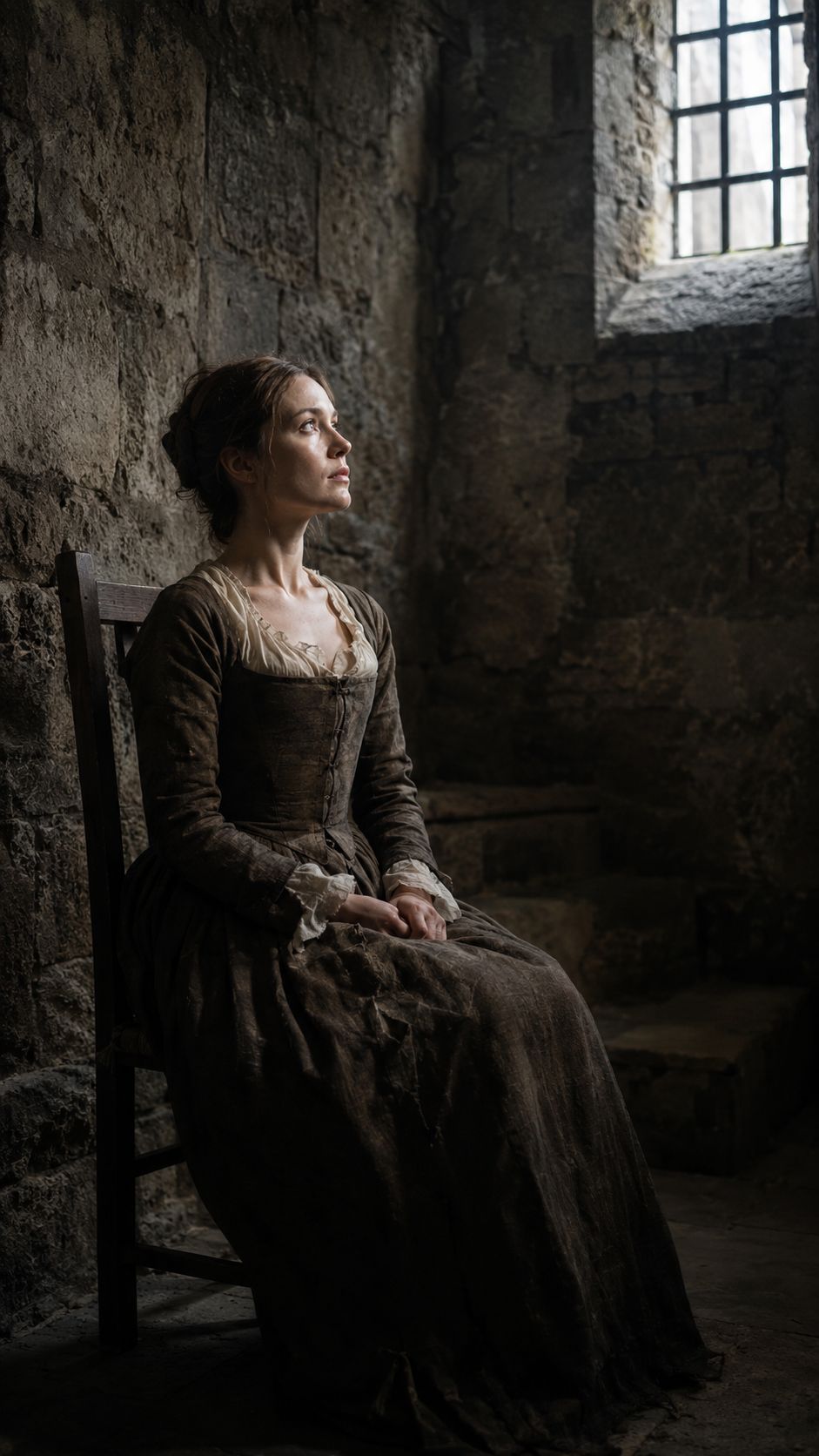 The Rape Trial That Ended In Trial By Combat
A woman's accusation of rape led to France's last judicial duel, with her own life staked on the outcome.
Paris, France · 1386
- The Parish Registers Of The Beast's Victims
Between 1764 and 1767 something killed roughly a hundred people, recorded in the registers as 'devoured by the beast.'
Saugues, France · 1764
- The Heretic Burned By The Reformers Who Fled Rome
Calvin's Geneva burned a brilliant Spanish physician for his beliefs, then, centuries later, erected a monument of atonement.
Champel, Geneva, Switzerland · 1553
- The Manufacturing Of England's Most Haunted House
For decades it was called the most haunted house in England, until its ghost story revealed how a haunting gets made.
Borley, Essex, United Kingdom · 1929