
The Favourite (2018) is one of the most critically acclaimed historical films of recent years — a darkly comic, sexually charged drama about two women competing for the affections of Queen Anne, played by Olivia Colman as a querulous, childish monarch easily manipulated by those around her. The film is stylish, funny, and brutal. But the real Queen Anne was not a pawn in a campy lesbian love triangle. She was a woman who had been pregnant 17 times, who had buried 17 children, and who spent her final years in such physical agony that she could not walk unassisted — a grieving mother trying to rule a kingdom while her body fell apart.
Anne was born in 1665, the daughter of James, Duke of York (later James II) and his first wife, Anne Hyde. She was not expected to rule. She was second in line to the throne, behind her father and then her older sister Mary. But the Glorious Revolution of 1688 swept her Catholic father into exile, and in 1702, after her sister’s death, Anne became Queen of England, Scotland, and Ireland. She was 37 years old. She had already been pregnant 13 times.
The Horror
Anne’s reproductive history is one of the most devastating medical records of any monarch in history. Between 1684 and 1700, she was pregnant 17 times. Of those 17 pregnancies, 5 resulted in live births. Of those 5 live births, only one child — Prince William, Duke of Gloucester — survived infancy. And he died in 1700, at the age of 11, after a sudden illness. The other 12 pregnancies ended in miscarriage, stillbirth, or neonatal death. Some of the stillborn children were so deformed that they could not survive. Anne suffered from gout so severe that by her thirties she could not walk without assistance; by her forties, she was carried in a sedan chair or pushed in a wheelchair. She was obese, possibly from the hormonal damage of repeated pregnancy and loss, and she was in constant pain.
The film The Favourite portrays Sarah Churchill, Duchess of Marlborough, and Abigail Masham as sexual rivals for Anne’s affection, trading kisses and caresses in shadowy palace corridors. The reality is more complex and more pathetic. Anne did have intense emotional attachments to women — first to Sarah, her childhood friend, later to Abigail, her cousin and bedchamber woman. But these relationships were likely not sexual in the modern sense. They were the attachments of a woman who had lost every person she had ever given birth to, who was in chronic pain, and who relied on female companions for emotional and physical support. Sarah Churchill was indeed a formidable political operator who used her influence over the Queen to advance her husband’s military career and her own Whig politics. Abigail Masham did replace Sarah in Anne’s affections, with the help of the Tory politician Robert Harley. But the film’s framing — Anne as a lustful, childish woman being sexually serviced by her favourites — strips away the genuine tragedy of her situation.
Anne died on 1 August 1714, aged 49. The immediate cause was a stroke, but her body had been failing for years. She was so obese that she had to be carried everywhere. Her gout was so severe that even the touch of bedsheets caused agony. She had no surviving children. The throne passed to her distant Protestant cousin, George of Hanover, because Parliament had passed the Act of Settlement 1701 to prevent Anne’s Catholic half-brother from inheriting. The film ends with Anne as a lonely, diminished figure. The reality was worse: she was a woman who had spent her adult life in a cycle of hope and bereavement, whose body had been ruined by the demands of producing an heir, and who died knowing that her dynasty — the Stuarts — ended with her.
The Modern Relic
The relic is her bed. Queen Anne’s state bed, an enormous gilded construction of carved wood and crimson velvet, is preserved at Hampton Court Palace. It is a monument to the theatrical display of monarchy — and to the woman who slept in it, who got into that bed pregnant 17 times and got out of it childless. You can see it today, behind a rope barrier, in the state apartments. The bed is vast, ornate, and empty. Anne’s tomb is in Westminster Abbey, alongside her husband Prince George of Denmark and her infant children. The film The Favourite was shot in Hatfield House and Hampton Court, using real palace rooms. But no amount of fisheye lenses or sexual intrigue can capture the reality of what that bed represented: a woman who gave her body to the throne, over and over, until there was nothing left.
Nearby on the Dark Atlas
 The Boys Who Inspired Peter Pan
Peter Pan is the boy who never grew up — but the real boys behind him did grow up, and for three of them it ended in horror.
London, United Kingdom · 1904 · same site
 The Jewel Sealed In Seven Boxes
A cursed gem terrified its final owner so badly he locked it away with occult charms and a plea to throw it in the sea.
London, United Kingdom · 1857 · 1.2 km away
- The Plot To Murder The Entire British Cabinet
A hayloft of desperate radicals plotted to assassinate the whole Cabinet in a single stroke, and very nearly tried.
Cato Street, London, United Kingdom · 1820 · 2.1 km away
 The Jesuit Who Chose the Rack Over the Court
The queen wanted him for her court, but he became a hunted priest facing rack, trial, and rope instead.
Tyburn, London, United Kingdom · 1581 · 2.2 km away
More like this
- The King's Favourite Who Bet Against Richelieu
A dazzling young courtier gambled his head against Cardinal Richelieu, and lost it in a public square.
Place des Terreaux, Lyon, France · 1642
- The Leper King's Story No Film Would Show
Kingdom of Heaven gave him a dignified death behind a silver mask, the truth was far crueller.
Jerusalem, Israel · 1185
- The Only Peer Ever Hanged At Tyburn
A violent nobleman was hanged before a stunned crowd who never expected to see a lord die on the public gallows.
Tyburn, London, United Kingdom · 1760
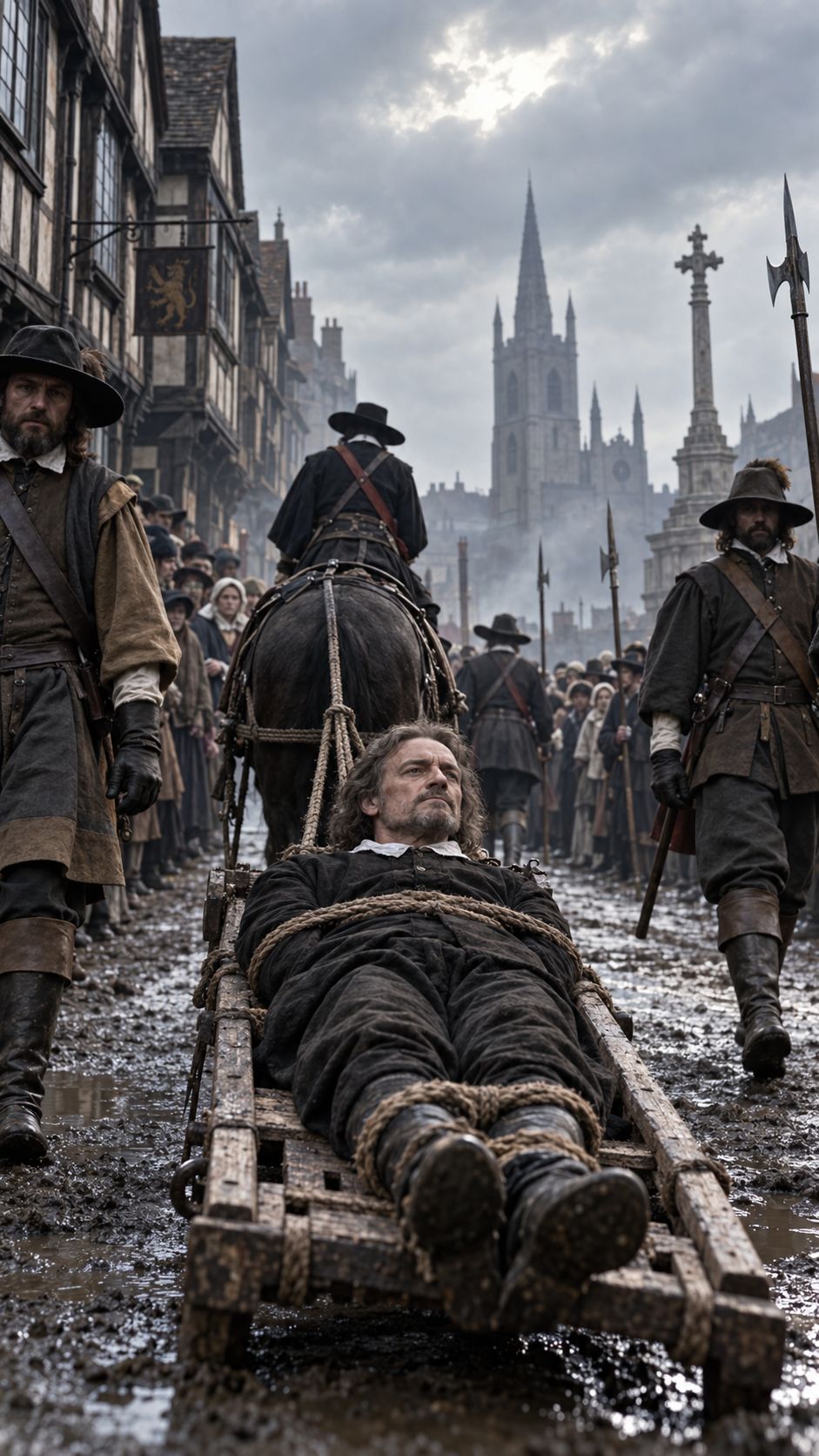 The Colonel Accused Of Plotting To Kill The King
A decorated officer was drawn on a hurdle and beheaded before twenty thousand silent Londoners for a plot historians still debate.
Horsemonger Lane, London, United Kingdom · 1803