
Disney’s Pocahontas gave millions of children a sweeping romance between a Native princess and a dashing English explorer, set amid enchanted forests and talking animals.
The real Pocahontas got none of it. Her life was shaped by war, abduction, forced conversion, political exploitation, and an early death thousands of miles from everything she knew — a life written down almost entirely by the people who profited from taking it.
Her personal name was Matoaka; Amonute was another name she carried. “Pocahontas” was probably a childhood nickname, meaning something like “playful one.” She was the daughter of Wahunsenacawh — known to the English as Powhatan — the paramount chief of a powerful alliance of Indigenous nations in what is now Virginia. When English colonists established Jamestown in 1607, she was about ten or eleven years old. A child. Not the grown woman the legend sends falling into the arms of the adult John Smith.
Even the one story everyone knows is not safe. The famous scene — Pocahontas throwing her body over Smith to save him from execution — comes from Smith’s own account, written years afterward, when it served him. No surviving Powhatan account confirms it. Some historians believe Smith misunderstood a ceremonial ritual; others question whether it happened at all. The foundation of the entire fairytale may be one man’s self-flattering memory.
The Horror
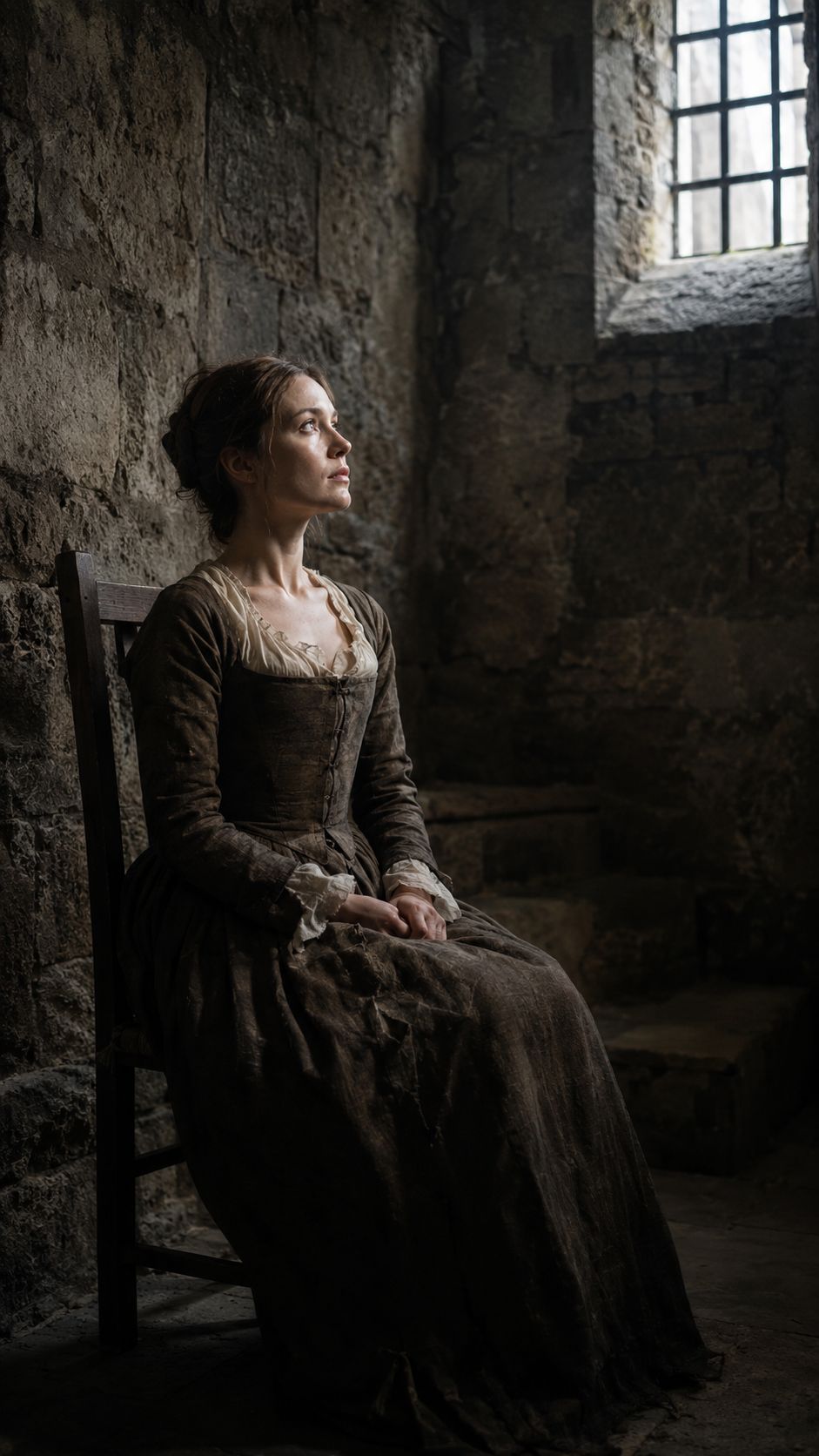
The decisive turn came in 1613, when the English captain Samuel Argall lured Pocahontas aboard his ship and took her captive. No lover came for her. She was seized as a political hostage and used as leverage against her own father in the war between the Powhatan peoples and the colony chewing at their land. She was a teenager, held prisoner by the invaders.
During her captivity at Henricus, Pocahontas was instructed in Christianity, baptised, and renamed Rebecca. Her own name was taken from her along with everything else. How freely she accepted any of it cannot now be known — it all happened while she remained a prisoner of the English. In 1614, still in captivity’s shadow, she married John Rolfe, the colonist whose tobacco had made Virginia valuable to England. The marriage bought several years of peace between the colonists and the Powhatan Confederacy. Whether affection existed between them is uncertain. What is certain is that this was not the romance Disney created — and John Smith was never her husband.
Mattaponi oral history preserves a far darker account of Pocahontas’s captivity than anything the English colonists wrote down. Some of its most disturbing details cannot be independently verified through surviving documents. But it remains an Indigenous perspective on a story that was recorded, from beginning to end, by the people holding her captive — and that silence in the record is its own kind of evidence.
In 1616, Pocahontas was shipped to England with Rolfe and their young son, Thomas. She was paraded before English society as living proof that Indigenous people could be converted and assimilated — a specimen of the colonial project’s success, her presence used to help the Virginia Company attract desperately needed investment. She attended court. She was brought before King James I. The supposedly “civilised” daughter of a powerful Native ruler, displayed like a marvel to a gawking nation that was, at that very moment, consuming her homeland. In March 1617, as the family prepared at last to sail home to Virginia, Pocahontas became gravely ill. She was taken ashore at Gravesend, and there she died, approximately twenty-one years old. The exact cause remains unknown — pneumonia, tuberculosis, dysentery have all been suggested. Mattaponi oral tradition holds that she may have been poisoned; no conclusive evidence has established it. What is established is simpler, and worse. She never made it home.
The Modern Relic
Pocahontas was buried at St George’s Church in Gravesend, England — thousands of miles from the rivers and forests where she had grown up. The exact location of her grave was later lost, after the original church was destroyed by fire in 1727. Even her resting place was taken from her. A bronze statue now stands in the churchyard, with another version at Jamestown in Virginia. Yet the most important memorial may be the continuing work of Indigenous historians and members of the Powhatan nations, who have spent decades challenging the romantic colonial legend and restoring to her story what it always buried: her childhood, her captivity, her name.
She was not a princess who abandoned her people for an English adventurer. She was a young Indigenous woman caught between two worlds, taken from her community and remade into a symbol for the very project that had invaded her homeland.
The real Pocahontas never got her fairytale.
She never even got to go home.
Nearby on the Dark Atlas
- The Boy King Whose Lungs Rotted Inside Him
His skin turned green and his legs swelled as he coughed up pieces of his own blackened lungs.
Greenwich Palace, London, United Kingdom · 1553 · 25 km away
 The Boy King's Hidden Collapse
Behind closed doors, the nine-year-old king who inherited a dynasty rotted from a lung disease his advisors desperately hid.
Greenwich, London, United Kingdom · 1553 · 26 km away
 The Pirate Queen Who Sailed To See A Queen
At sixty-three, a sea-captain and pirate chieftain sailed straight to England to demand an audience with Elizabeth I.
Greenwich, London, United Kingdom · 1593 · 26 km away
 The Playwright Killed Over A Dinner Bill
England's most celebrated playwright spends a day eating and talking at a Deptford lodging house, then dies over an argument about who pays.
Deptford, London, United Kingdom · 1593 · 28 km away
More like this
- The King's Favourite Who Bet Against Richelieu
A dazzling young courtier gambled his head against Cardinal Richelieu, and lost it in a public square.
Place des Terreaux, Lyon, France · 1642
- The Leper King's Story No Film Would Show
Kingdom of Heaven gave him a dignified death behind a silver mask, the truth was far crueller.
Jerusalem, Israel · 1185
- The Only Peer Ever Hanged At Tyburn
A violent nobleman was hanged before a stunned crowd who never expected to see a lord die on the public gallows.
Tyburn, London, United Kingdom · 1760
 The Rape Trial That Ended In Trial By Combat
A woman's accusation of rape led to France's last judicial duel, with her own life staked on the outcome.
Paris, France · 1386