
The death of the Chevalier de la Barre in 1766 is one of the most shocking miscarriages of justice in French history — a case so grotesque that it helped fuel the fury against the old regime that would explode in the French Revolution a generation later. It is the story of a state that tortured a teenager to death over a hat.
His name was François-Jean Lefebvre de la Barre, and he was a nineteen-year-old minor nobleman, an orphan being raised by an abbess relative in the town of Abbeville in northern France. He was, by all accounts, a high-spirited, rebellious, irreligious young man — the kind of teenager who read forbidden books, sang bawdy songs, and mocked the pieties of his elders. In the Enlightenment, ideas questioning the absolute authority of the Church were spreading among the young and educated. La Barre was caught up in that spirit. And it made him a target.
The Horror
In August 1765, a wooden crucifix on a bridge in Abbeville was found vandalised — damaged, possibly by a knife. The town’s devout authorities were scandalised, and they wanted someone to blame. Suspicion fell on a group of local young men known for their irreverence — and above all on the Chevalier de la Barre.
There was never any real evidence that la Barre had damaged the crucifix. But as the investigation gathered pace, a list of his other “crimes” was assembled from local gossip and the testimony of people with grudges against him. The charges that emerged were these: that he had passed within about twenty-five paces of a religious procession — a Corpus Christi procession — without removing his hat or kneeling as it went by. That he had sung two obscene, blasphemous songs. And that he had shown disrespect for religion and possessed forbidden books — including a copy of Voltaire’s Philosophical Dictionary, the great banned text of the Enlightenment, found in his room.
That was the case. A young man who didn’t doff his hat, sang rude songs, and read Voltaire.
For this, on the 28th of February 1766, the magistrates of Abbeville found the nineteen-year-old guilty of “monstrous, execrable blasphemies,” and handed down a sentence of almost unbelievable savagery. The Chevalier de la Barre was condemned: first to be tortured to make him confess and name his accomplices; then to have his tongue cut out; then to have his right hand cut off; then to be beheaded; and finally to have his body burned to ashes and scattered to the wind.
La Barre appealed. The case went all the way up to the Parlement of Paris, the highest court — and the judges of Paris, far from being appalled, upheld the death sentence. They added just one refinement of their own: that Voltaire’s Philosophical Dictionary should be burned on the pyre together with the young man’s body. King Louis XV was petitioned to grant a pardon. He refused.
On the 1st of July 1766, the sentence was carried out at Abbeville. In the morning, la Barre was subjected to torture — the “question” — his legs crushed to force him to name the others who had been with him. He passed out from the pain, was revived, and, even in that agony, refused to betray his friends. He would not name a single accomplice, insisting he had none to give.
Then he was taken to the scaffold, in his shirt, a rope around his neck, a placard on his back reading “impious, blasphemous and execrable sacrilege.” And here, something remarkable happened. The nineteen-year-old faced his horrific death with such astonishing composure and courage that it unsettled his executioners. He mounted the scaffold steps without hesitation or fear. His bearing was so dignified, so brave, that the authorities decided not to carry out the tearing-out of his tongue and the cutting-off of his hand after all. Instead, the executioner beheaded him with a single stroke of a sabre.
His body was then thrown onto the pyre — and with it, nailed to the corpse, a copy of Voltaire’s Philosophical Dictionary, the book they had killed him for owning, burned together with the boy.
THE MODERN RELIC The execution horrified even many who witnessed it, and it soon horrified all of enlightened Europe — because of one man. Voltaire, the greatest writer of the age, who had already fought to clear the name of the executed Jean Calas, was appalled by the killing of la Barre. He was especially outraged that his own book had been burned on the boy’s body, making it clear the real target was the Enlightenment itself. Voltaire took up la Barre’s cause with all his fury, writing pamphlets and accounts that spread the story across Europe, holding up the case as monstrous proof of the barbarity, fanaticism, and injustice of religious intolerance and the old order. The Chevalier de la Barre became a symbol — alongside Calas — of everything the Enlightenment was fighting against.
And history vindicated him completely. During the French Revolution, in 1793, the National Convention formally reversed the verdict and rehabilitated the Chevalier de la Barre, declaring him not a blasphemer but a victim of superstition and fanaticism — an innocent young man judicially murdered by a cruel and dying regime.
The relics are monuments to that vindication, and you can visit them. In Paris, at the very summit of the hill of Montmartre, in the shadow of the great white basilica of the Sacré-Cœur, stands a statue of the Chevalier de la Barre — the teenager placed among the heroes of free thought, a rallying point for defenders of secularism and liberty of conscience to this day. And in Abbeville, where he died, another monument stands, its inscription remembering “the Martyrdom of the Chevalier de La Barre, tortured at Abbeville on 1 July 1766, at the age of 19, for having failed to salute a procession” — the bronze so cherished that when the Nazis tried to melt it down in the war, a railway worker hid it in a stream to save it.
A nineteen-year-old boy, tortured and beheaded and burned for a hat, a song, and a book — who wouldn’t betray his friends even under torture, and who faced his death so bravely that his killers lost the stomach to complete their own sentence. He is remembered not for what he did, but for what was done to him — and for the great writer who made sure the world would never forget it.
Nearby on the Dark Atlas
 The Teenage Warrior Burned As A Heretic
A nineteen-year-old who turned the tide of a war is condemned to death not for anything military, but for the clothes she wore.
Rouen, France · 1431 · 91 km away
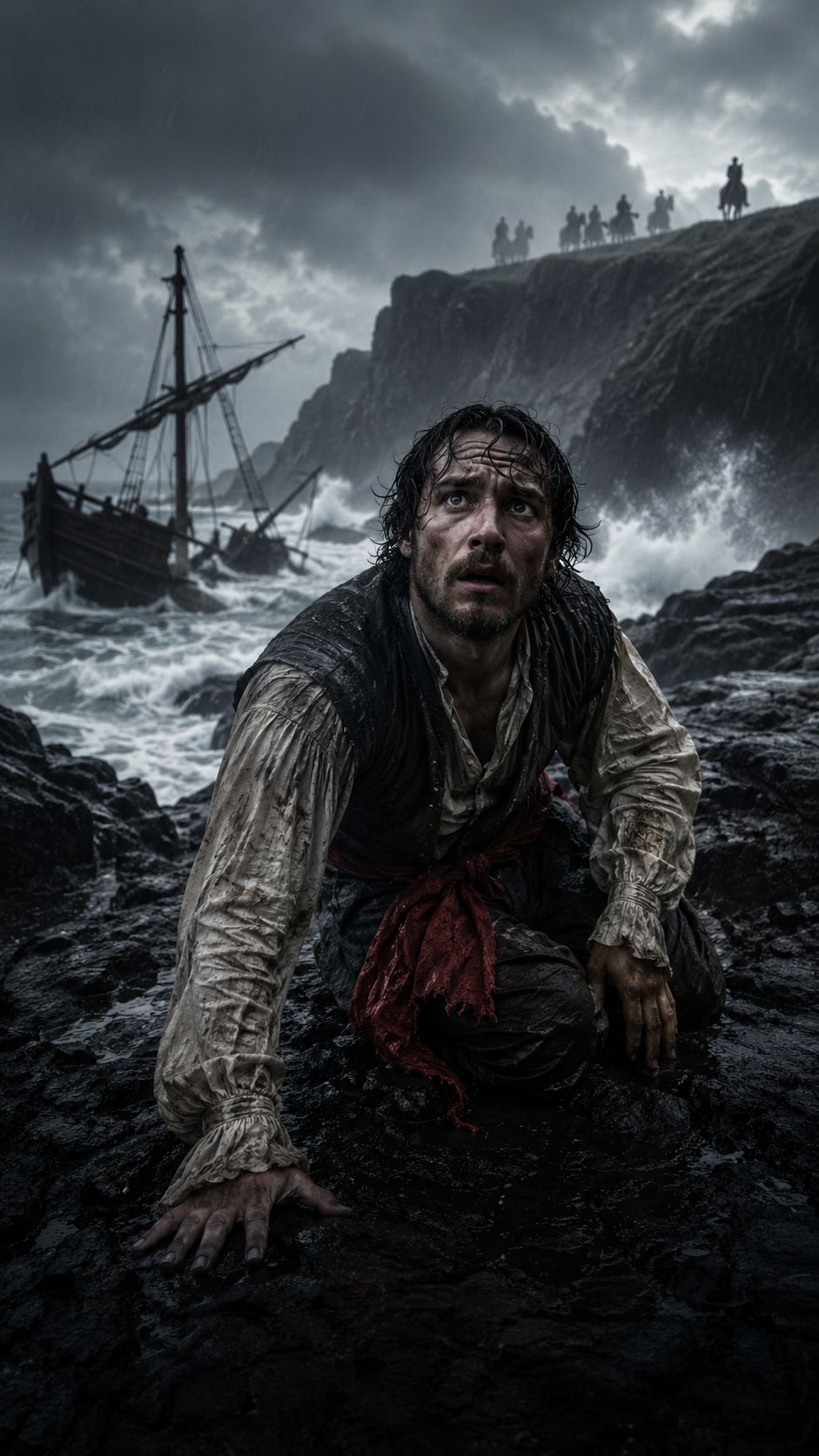 The Armada's Graveyard After The Battle
England celebrated a legendary naval victory, but thousands more Spanish sailors died in the storms and wrecks that followed.
Gravelines, France · 1588 · 100 km away
- The Gas Attack That Tore Open The Line
German forces released a poison cloud that dissolved men's lungs from the inside in minutes.
Ypres, Belgium · 1915 · 111 km away
 Was Van Gogh's Death Not A Suicide
A dying artist may have covered for the boys who accidentally shot him rather than name them.
Auvers-sur-Oise, France · 1890 · 117 km away