
For roughly six centuries — from the early 1200s until 1835 — the Tower of London was not just a fortress, a royal residence and a prison. It was also a zoo.
A working, public, occasionally lethal zoo filled with lions, bears, monkeys, wolves and other exotic animals that English monarchs had been given as diplomatic gifts and had almost no idea how to care for.
The Horror
The story starts in 1235, when Holy Roman Emperor Frederick II sent Henry III three “leopards” — almost certainly lions, meant to match the three lions on the English royal coat of arms. Henry needed somewhere to keep them. He chose the Tower.
In 1252, King Haakon IV of Norway sent a polar bear. Feeding a polar bear in medieval London was an immediate problem. The sheriffs of London were ordered to cover the cost and quickly decided to let the bear catch its own fish. They muzzled it, chained it, and led it down to the Thames, where it swam on a tether and fished in the river, watched by keepers on the bank holding the rope.
In 1255, King Louis IX of France sent an elephant — the first seen in England since Roman times. A special wooden house was built for it near the Tower’s western gate. The keepers, who had never seen an elephant before, assumed it was a carnivore. It was fed meat and given wine to drink. It died within a couple of years.
By Elizabeth I’s reign, the royal menagerie was open to paying visitors. Admission cost three half‑pence — or, if you couldn’t pay, you could enter free by bringing a cat or dog to be thrown to the lions. The price of a ticket was a pet.
Accidents and incidents piled up over the centuries.
In the 1680s, Mary Jenkinson from Norfolk reached through bars to stroke a lion’s paw. The lion grabbed her arm and mangled it so badly surgeons amputated. She died soon afterwards.
A baboon being transported by ship to the Tower broke loose, picked up a cannonball and threw it at a young sailor, killing him.
A large snake later tried to constrict a keeper, Alfred Copps; assistants had to force its jaws open and reportedly broke its teeth to free him.
At least one wolf escaped from the Tower menagerie and was never recovered.
Over time, monkeys and other animals bit visitors and staff, including members of the nobility.
By the early 19th century, attitudes toward animal welfare and public safety were changing. In the 1830s, after a monkey bit a nobleman, Arthur Wellesley, Duke of Wellington and Constable of the Tower, decided enough was enough. He ordered the menagerie closed.
The animals were moved to the new Zoological Gardens in Regent’s Park — the beginnings of London Zoo. The Tower returned to being a fortress and tourist site without living lions in its gateways.
The Modern Relic
The old Lion Tower, which once housed many of the beasts, was demolished in the 19th century. No intact animal enclosures from the medieval menagerie remain above ground. But the memory is deliberately kept alive.
In the 2010s, artist Kendra Haste was commissioned to create life‑size wire sculptures of some of the Tower’s former residents. Ghostly lions, a polar bear, baboons and an elephant made of galvanised wire now stand in and around the Tower grounds where real animals once paced and roared. You can see the stone through them. They look like memories given shape.
Around three million people visit the Tower of London every year. They come for the Crown Jewels, the ravens, the stories of beheadings and imprisonment. They pass by wire animals and small plaques noting the old menagerie.
Very few realise that for 600 years, the most infamous prison in England was also a zoo — a place where a polar bear swam in the Thames on a chain, an elephant drank wine and died, a baboon killed a sailor with a cannonball, and anyone who couldn’t pay cash for entry could pay with a cat.
The animals left. The walls stayed. If ghosts exist, the Tower has more than enough for both.
Nearby on the Dark Atlas
 Fourteen Years in the Tower for His Bloodline
Locked away as a boy for the crime of his birth, he emerged so isolated he could no longer recognize an animal.
Tower of London, London, United Kingdom · 1499 · same site
 Poisoned in the Tower Over a Marriage
Imprisoned on a diplomatic post designed to fail, he died slowly of a poison that took months to finish the job.
Tower of London, London, United Kingdom · 1613 · same site
 The Archbishop's Head That Still Survives
A raging mob hacked the Archbishop of Canterbury to death, and his mummified head still sits in a Suffolk church today.
London, United Kingdom · 1381 · same site
 The Birds Whose Wings Are Clipped Forever
Legend says England falls the day these birds leave the Tower, so their flight feathers are trimmed to make sure they never can.
Tower of London, London, United Kingdom · 1600 · same site
More like this
- The King's Favourite Who Bet Against Richelieu
A dazzling young courtier gambled his head against Cardinal Richelieu, and lost it in a public square.
Place des Terreaux, Lyon, France · 1642
- The Leper King's Story No Film Would Show
Kingdom of Heaven gave him a dignified death behind a silver mask, the truth was far crueller.
Jerusalem, Israel · 1185
- The Only Peer Ever Hanged At Tyburn
A violent nobleman was hanged before a stunned crowd who never expected to see a lord die on the public gallows.
Tyburn, London, United Kingdom · 1760
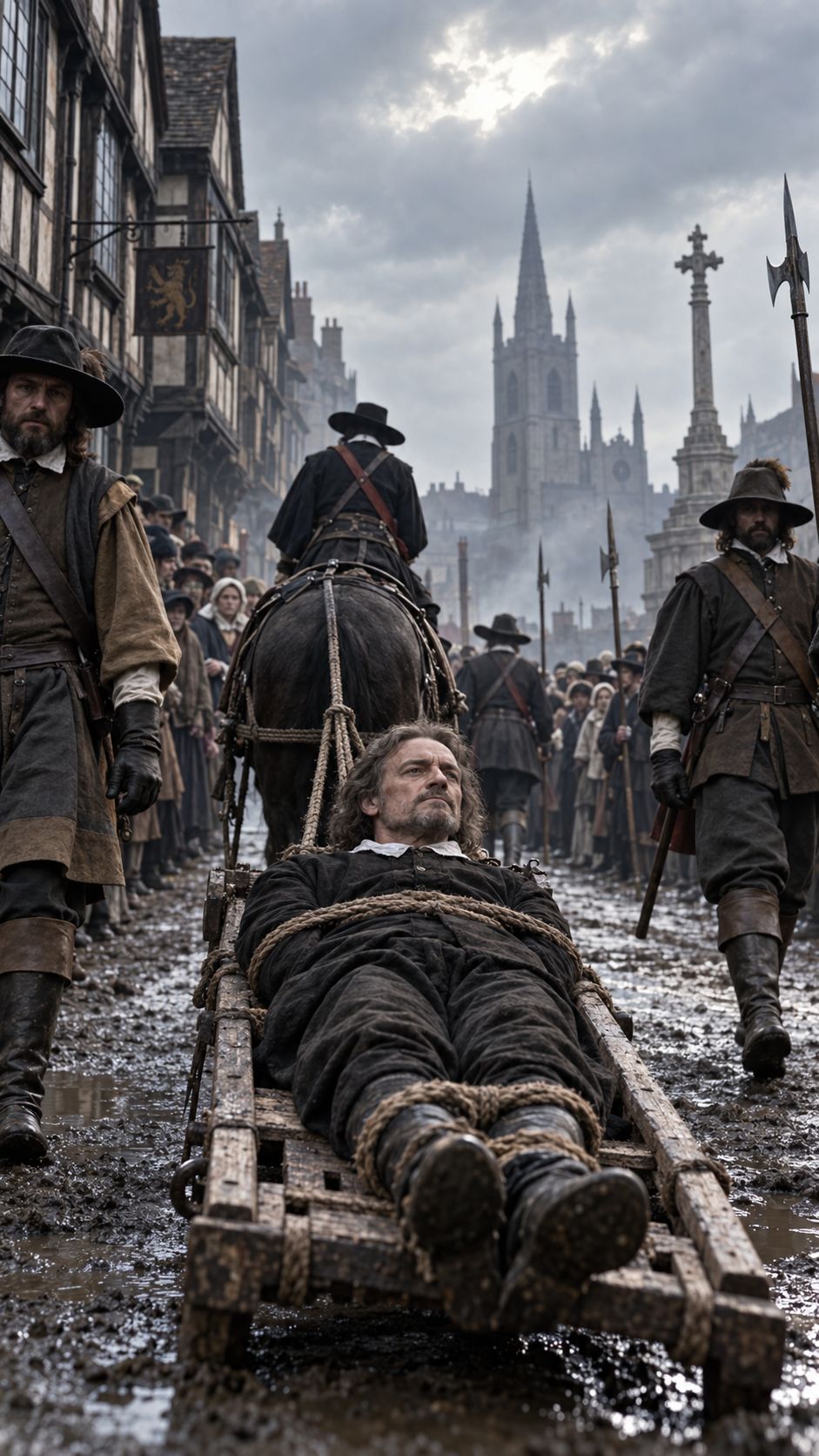 The Colonel Accused Of Plotting To Kill The King
A decorated officer was drawn on a hurdle and beheaded before twenty thousand silent Londoners for a plot historians still debate.
Horsemonger Lane, London, United Kingdom · 1803